

the US just signed its surrender to Iran.
a $300 billion reconstruction fund, all sanctions lifted, the Strait of Hormuz still in Iranian hands, and not a single one of Washington’s war aims achieved—the art of the deal.

Good day, spectators,
And, let’s talk about a war that was supposed to be over in days, sold to the public with the familiar confidence of people who have never been wrong because…well, they have never been held accountable for being wrong. It was a war that was supposed to bring the Iranian ‘regime’ to its knees, demonstrate the unassailable might of American military power, and settle, once and for all, the question of who runs the Middle East. The United States and its lackey Israel entered this conflict with maximalist goals and the unshakeable conviction that the Islamic Republic, faced with the full force of the world’s most expensive military, would simply fold.
It did not fold.
On Wednesday, the United States and Iran signed a memorandum of understanding to formally end hostilities and reopen the Strait of Hormuz. The 14-point agreement commits the US to lifting its naval blockade, ending all sanctions, releasing billions in frozen Iranian assets, and contributing to a $300 billion reconstruction fund for the country it just spent months trying to destroy.
Watch: Trump signs the memorandum, ironically in the Palace of Versailles.
In return, Iran has offered a vague promise not to develop nuclear weapons, with the details of that promise deferred for another 60 days of negotiation. Iran’s nuclear programme remains intact. Its ballistic missile programme is untouched. Its support for regional resistance movements continues. And the Strait of Hormuz, through which roughly one fifth of the world’s oil passes, remains firmly under Iranian control, with nothing in the agreement requiring Tehran to relinquish that position.
Trump will sell this as a great deal but we know it’s a poorly dressed-up surrender.
what did the US lose?
The Trump administration has been, understandably, reluctant to release the text of the agreement. When it finally did, a senior official read it aloud on a briefing call rather than publish it online, presumably because anyone who could read would be able to see immediately what it says. Senator Bill Cassidy of Louisiana, no peacenik, called it ‘the worst foreign policy blunder in decades.’ ‘Reagan is rolling over in his grave,’ he wrote. ‘Iran’s nuclear ambitions were not curbed, and they have learned that threatening the Strait works.’
He is not wrong, though I think it’s fun to note the irony of a Republican senator discovering the limits of military adventurism only when it is his own party doing the adventuring.
The military losses alone are extraordinary. At least 42 US military aircraft were lost or damaged during the war, among them 24 MQ-9 Reaper drones, seven KC-135 refuelling aircraft, and four F-15E fighter jets. Hundreds of service members were injured. The USS Gerald R. Ford, the Navy’s newest and most expensive aircraft carrier, was damaged. Billions in equipment destroyed.
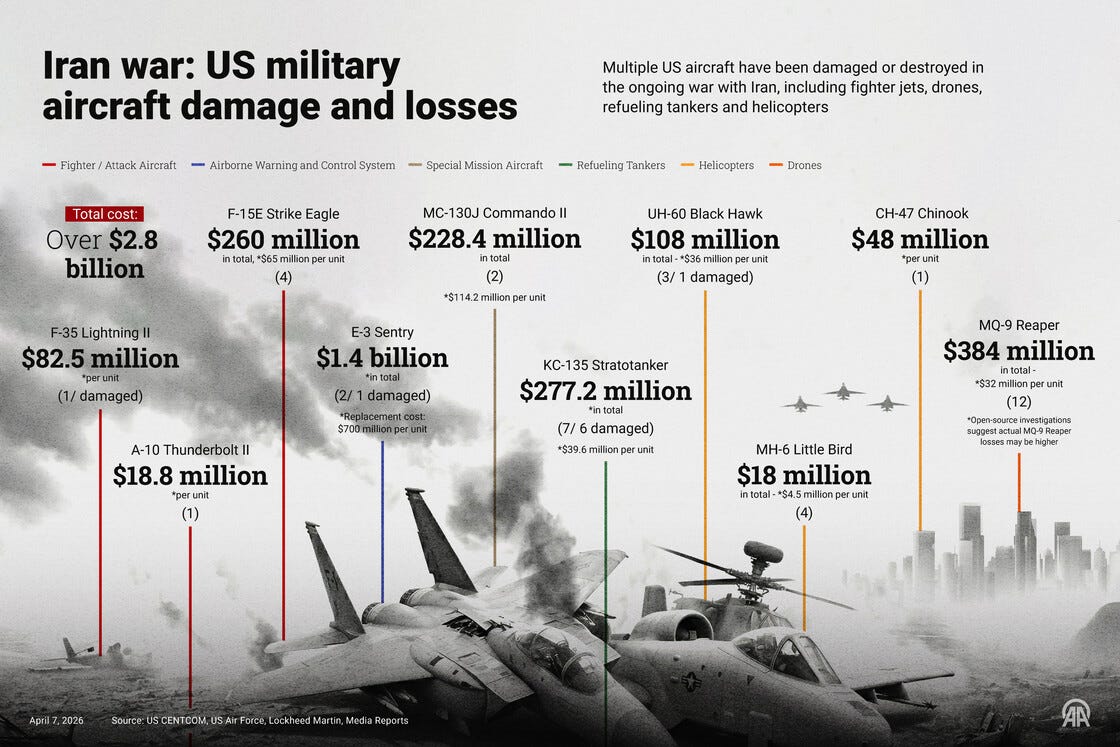
And for what? The United States entered this war with three clear objectives: eliminate Iran’s nuclear programme, destroy its ballistic missile programme, and end its support for Hezbollah and Hamas. It exits with none of those achieved. Iran’s nuclear programme is paused, not dismantled. Its missiles are intact. Hezbollah is intact. Hamas is intact. Barbara Leaf, a former US assistant secretary of state, told the Guardian that the war had begun with ‘disastrously unrealistic assessments of the regime’s resilience’ and that Iran’s seizure of the Strait had made continuing ‘untenable.’
Trump himself admitted as much, warning that the alternative to the deal was a ‘worldwide depression.’ When the president of the United States frames his negotiating position as ‘sign this or the global economy collapses,’ you have already lost.
Iran’s Rear Admiral Habibollah Sayyari declared victory before the ink was even dry. On the 13th of June, he said:
‘The Strait of Hormuz and the Persian Gulf are firmly under the control of Iran’s naval forces. No vessel can pass through without Iran’s permission.’
The agreement does not contradict him on a single point.
the Empire’s oldest habit.
But there is so much to say about American military disasters: they follow a pattern so consistent, so bloody repetitive, that one begins to wonder whether the people planning these wars have ever read a history book, or whether they have read one and simply concluded that ‘this time will be different’.
Korea. The United States entered in 1950 with the goal of rolling back communism on the peninsula and ended three years later with an armistice that left the border almost exactly where it started and a North Korean state that exists to this day, now with nuclear weapons. Of course, they first had to genocide a third of North Korea’s population and destroy 100% of its infrastructure but they don’t talk about that. Vietnam. The mightiest military power in history spent two decades and 58,000 American lives and countless Vietnamese trying to prevent a communist government from taking power in Saigon. The communist government thankfully took power in Saigon. Laos. The same shit. The CIA ran a secret war for years, carpet-bombing a country that had nothing to do with anything, and achieved nothing except the deaths of hundreds of thousands of civilians and the creation of an unexploded ordnance crisis that kills people to this day. Afghanistan. Twenty years, two trillion dollars, and the Taliban are back in power as if the whole thing never happened.
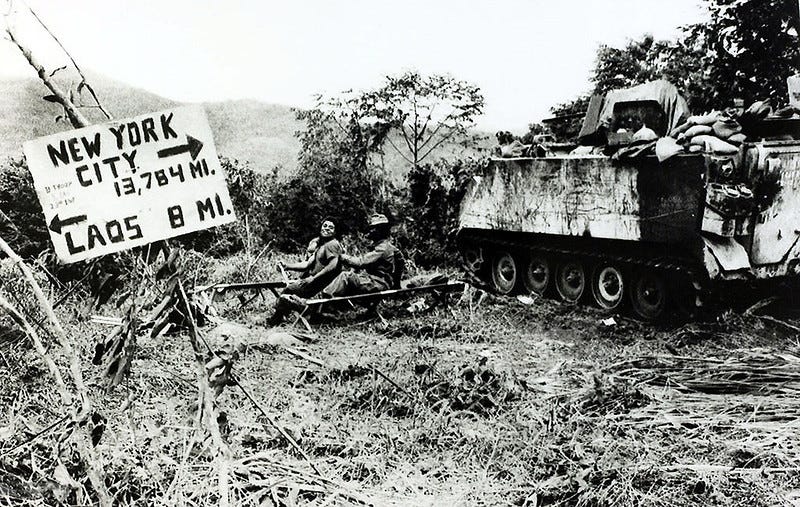
Each time it is the the very same story. The war is launched with maximalist rhetoric and minimal planning. The enemy refuses to behave as expected. The costs mount. The public grows restless. The goals are quietly revised downward. And eventually, someone signs a piece of paper and calls it peace. The only variable is how long the whole charade takes and how many people die in the meantime.
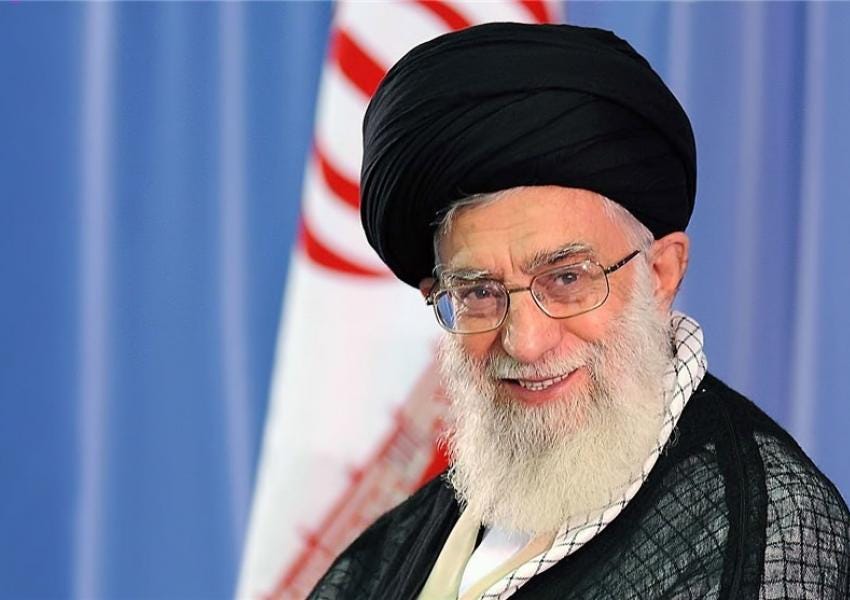
What makes Iran different, and what makes this particular humiliation sting more than most, is that Iran did not even need to defeat the United States on a battlefield. It simply closed a waterway, held its ground, absorbed the strikes, replaced its assassinated supreme leader with his son, and waited. The decapitation strike that killed Khamenei and nearly 40 senior Iranian leaders did not, as its architects presumably hoped, produce chaos and capitulation. It produced consolidation. The Iranian state proved more resilient than Washington’s analysts imagined, which is remarkable only if you have been paying no attention whatsoever to the last 45 years of Iranian history.
what Iran won.
Iran won, in the most straightforward sense of that word, almost everything it wanted from this conflict. It withstood over three months of bombardment by the most expensive military in human history and emerged with its government intact, its nuclear programme intact, its missile programme intact, and its regional influence intact. It inflicted billions in damage on US forces. It demonstrated to every country in the world currently living under the shadow of American military threat that the United States can be beaten, not necessarily on the battlefield, but in the longer game of political endurance and strategic patience. And it now sits on a $300 billion reconstruction commitment, with sanctions lifted and frozen assets released, in a far stronger position than it occupied before the war began.
The supreme leader was killed. They got a new one. The government was targeted. It survived. The population, faced with the choice between the Islamic Republic and American bombs, chose the former, as populations under foreign assault tend to do, as they have always done, as any serious student of history would have predicted they would do. The US bombing campaign did not fracture Iranian society. It unified it, in the way that bombing campaigns have always unified the societies on the receiving end, from London in 1940 to Gaza today.

Gulf states, meanwhile, are watching all of this and drawing their own conclusions. Foreign Affairs notes they are ‘losing faith that Washington is committed to ensuring their security,’ which is a polite way of saying that American security guarantees are beginning to look like the cheques written by someone who has already overdrafted. The diplomatic isolation that accompanied the war, the failure to build a coalition, the failure to make a credible case for Iranian threat, the alienation of regional partners, will take years to repair. Probably even decades, if at all.
The Empire went looking for a demonstration of its power and found a demonstration of its limits. That is the agreement signed on Wednesday and that is what history will record.
So the next time a Western politician or think-tank expert or newspaper editorial board tells you that American military power is the guarantor of global stability, point them at the Strait of Hormuz which is still rightfully under Iranian control. Point them at the $300 billion reconstruction bill, being footed by the country that started the war. Point them at the 60-day negotiation window that Iran will use to rebuild, rearm, and prepare. The United States has not ended anything. It has purchased a pause, at enormous cost, on terms dictated by the side it was supposed to defeat and it’s beautiful. This is what imperial overreach looks like in the twenty-first century. The weapons are more expensive. The press releases are more sophisticated. But the outcome is Korea, it is Vietnam, it is Afghanistan, it is the oldest story the Empire tells about itself, the one it spends decades trying to forget.
And on that thought, I’ll let you go,
(As always, thanks for reading, make sure to subscribe and do please give this post a ❤️ and restack below too.)


I really need your support:
At the moment, I am under immense financial pressure exacerbated by an unexpected move which was unaffordable and stressful. If you’ve enjoyed the spectacle in the past few months, please consider leaving a small tip below. If even just 10% of people reading this post ‘bought a coffee’ just *one* time a month, I could dedicate myself to this work full time and expand to bring you even more unfiltered, independent stories, every single day.
Every contribution counts and is deeply appreciated. Thank you for being part of this community.
Read more from the magazine:


It will be interesting to see what happens when Israel continues to ignore the terms of the deal, as we know they will. Will the US dare to actually stop funding Israel? (I doubt it). Will Iran defend the terms of the deal by retaliating against Israel and ultimately freeing Palestine (though this needs to happen now!)?
Yayyyyy. The US and Israel shouldn’t have started another illegal war. Now if only Israel would get out of the way and be decent humans and withdraw from invading yet another sovereign country - our world can breath a sigh of relief that energy prices can come down and that hospitals can function more easily. But Israel has broken every ceasefire deal thousands of times. Our world now needs to put pressure on Israel to completely withdraw from Lebanon. This greater Israel plan is simply a massive war crime after war crime. They have no right to sabotage this plan for genuine peace in the middle east.